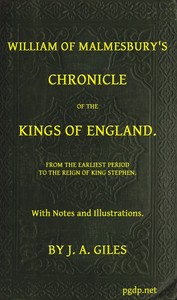
William of Malmesbury's Chronicle of the Kings of England by of Malmesbury William

(5 User reviews)   634
By Jason Bauer Posted on Jan 12, 2026
In Category - Wit & Irony
William, of Malmesbury, 1090?-1143 William, of Malmesbury, 1090?-1143
English
Imagine finding a secret diary from 900 years ago, written by a clever monk who knew all the gossip about kings and queens. That's William of Malmesbury's Chronicle. It's not a dusty list of dates. It's the real, messy, and sometimes shocking story of England's rulers from the Romans to the 12th century. Think of it as the original 'Game of Thrones,' but with real battles, betrayals, and saints. William had strong opinions, and he wasn't afraid to share them. Want to hear what a medieval mind really thought about power and corruption? This is your backstage pass.
Share

Read "William of Malmesbury's Chronicle of the Kings of England by of Malmesbury William" Online

This book is available in the public domain. Start reading the digital edition below.

START READING FULL BOOK
Instant Access    Mobile Friendly

Book Preview

A short preview of the book’s content is shown below to give you an idea of its style and themes.

the only man of his time who has discharged his trust as an historian. His History of the Kings of England was translated into English by the Rev. John Sharpe, and published in quarto, in 1815. Though the language of Mr. Sharpe’s work is by no means so smooth as the dialect of the present day would require, yet the care with which he examined MSS., and endeavoured to give the exact sense of his author, seemed so important a recommendation, that the editor of the present volume has gladly availed himself of it as a ground-work for his own labours. The result of this plan is, that the public are enabled to purchase without delay and at an insignificant expense, the valuable contemporary historian, who has hitherto been like a sealed book to the public, or only accessible through a bulky volume, the scarcity of which served to exclude it from all but public libraries or the studies of the wealthy. But the translation of Mr. Sharpe has by no means been reprinted verbatim. Within the last ten years a valuable edition of the original text, with copious collations of MSS., has been published by the English Historical Society. This edition has been compared with the translation, and numerous passages retouched and improved. Some charters, also, have been added, and a large number of additional notes appended at the foot of the pages, together with a few other improvements and additions calculated to render this interesting history more acceptable to the reading public. J. A. G. _Bampton, June, 1847._ THE TRANSLATOR’S PREFACE. The author whose work is here presented to the public in an English dress, has, unfortunately, left few facts of a personal nature to be recorded of him; and even these can only be casually gleaned from his own writings. It is indeed much to be regretted that he who wrote so well on such a variety of topics, should have told so little to gratify the curiosity of his readers with respect to himself. Every notice of such an ardent lover of literature as Malmesbury, must have been interesting to posterity, as a desire to be acquainted with the history of those who have contributed to our instruction or amusement seems natural to civilized man. With the exception indeed of the incidental references made by successive chroniclers, who borrowed from his history, there is nothing to be learned of him from extrinsic sources till the time of Leland, who indignantly observes, that even at Malmesbury, in his own monastery, they had nearly lost all remembrance of their brightest ornament. To himself then we are indebted for the knowledge of his being descended from both English and Norman parents; his father having probably come hither at the conquest. The exact time of his birth cannot be ascertained; though perhaps an approximation to it may be made. In the “Commentary on Jeremiah,”[1] Malmesbury observes, that he “had long since, in his youthful days, amused himself with writing history, that he was now forty years of age;” and, in another place, he mentions a circumstance which occurred “in the time of king Henry;”[2] apparently implying that Henry was then dead. Now, admitting the expression of “long since” to denote a period of ten years, this, as his “Histories of the Kings” and “of the Prelates” were completed in the year 1125, must have been written about 1135, the time of Henry’s death, and would of course place his own birth about 1095 or 1096.[3] The next circumstance to be noticed is, that when a boy, he was placed in...

This is a limited preview. Download the book to read the full content.

This isn't a novel with a single plot. It's a grand, sweeping account of England's history from its earliest legends right up to William's own time in the 12th century. William, a monk and librarian, collected stories from older books, local tales, and eyewitness accounts to piece together the lives of kings, saints, and sinners. He starts with the Britons and Romans, moves through the Anglo-Saxon kingdoms, and gives us a front-row seat to the drama of the Norman Conquest in 1066. The 'story' is the rise and fall of dynasties, the clash of swords and wills, and the constant struggle for a kingdom's soul.

Why You Should Read It

You read this for William's voice. He's a brilliant, witty, and often frustrated narrator. He praises good kings who built churches and kept peace, and he openly scolds the bad ones for being greedy, lazy, or cruel. He's fascinated by stories of miracles and relics, but he's also skeptical enough to question the wilder tales. Reading him feels like having a conversation with the smartest person in the monastery. You get history, but you also get a powerful sense of what one man believed was right, wrong, and truly important.

Final Verdict

Perfect for history lovers who want to go beyond the facts and hear the human voice behind them. It's for anyone curious about how people in the Middle Ages saw their own past. It requires a bit more focus than a modern book, but the reward is immense: you're seeing history through the eyes of someone who was helping to invent it. If you've ever wondered what a thoughtful person made of kings like Alfred the Great or William the Conqueror, this is your chance to find out.


🔓 Copyright Status

This work has been identified as being free of known copyright restrictions. You do not need permission to reproduce this work.

Robert Mitchell
5 months ago

For a digital edition, the author demonstrates strong mastery of the topic. I finished this feeling genuinely satisfied.

Noah Johnson
5 months ago

I didn't expect much, but the emotional weight of the story is balanced perfectly with moments of levity. Time very well spent.

Jessica Wright
2 months ago

My professor recommended this and it challenges the reader's perspective in the most intellectual way. It was exactly what I needed right now.

Margaret Davis
2 months ago

A fantastic discovery, the author demonstrates strong mastery of the topic. Well worth recommending.

Deborah Garcia
2 months ago

From an academic standpoint, the explanations feel carefully crafted rather than rushed. I'm sending the link to all my friends.

4
4 out of 5 (5 User reviews )

Add a Review

Your Rating *
There are no comments for this eBook.
You must log in to post a comment.
Log in

Related eBooks